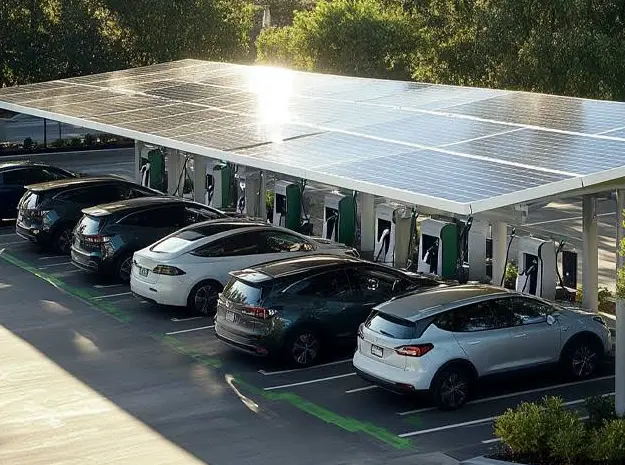
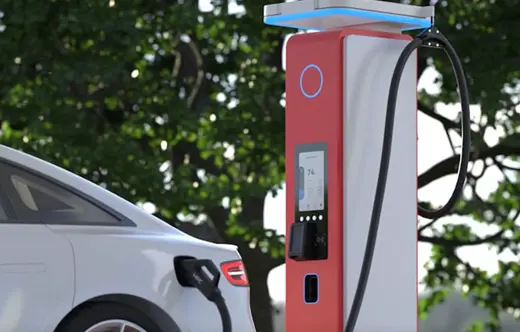
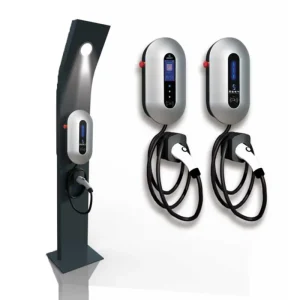
A 7kW AC EV charger is generally suitable for homes, apartments and locations where vehicles remain parked for several hours. A 22kW AC EV charger is better suited to workplaces, hotels, fleet depots and commercial parking sites that have three-phase power and need faster vehicle turnaround.
Dingsheng Electric supplies AC and DC EV charging equipment for residential, workplace, fleet and commercial charging projects.
However, a 22kW charger will not necessarily charge every vehicle three times faster than a 7kW charger. Actual charging speed depends on the vehicle’s onboard AC charger, the available electrical supply, cable capacity and site load-management settings.
7kW vs 22kW EV Charger: Quick Comparison
| Feature | 7kW AC EV Charger | 22kW AC EV Charger |
| Typical electrical supply | Single-phase | Three-phase |
| Typical rated current | Approximately 32A | Approximately 32A per phase |
| Maximum rated power | About 7kW | Up to 22kW |
| Common application | Home and long-stay parking | Workplace and commercial charging |
| Installation complexity | Relatively simple | More complex |
| Charging a 60kWh battery | Approximately 9–10 hours | Approximately 3 hours at full power |
| Vehicle requirement | Widely compatible | Vehicle must support high-power AC charging |
| Typical parking duration | Overnight | One to several hours |
| Infrastructure cost | Lower | Higher |
| Best suited for | Homes, apartments and small offices | Hotels, fleets and commercial parking |
The charging times in this table are estimates. Battery temperature, state of charge, charging losses, power sharing and vehicle limitations can affect actual performance.
Related Dingsheng EV Charging Products
What Is an AC EV Charger?
An AC EV charger supplies alternating current to an electric vehicle. The vehicle’s onboard charger converts the AC electricity into direct current before storing it in the traction battery.
This is different from a DC fast charger. A DC charger converts electricity outside the vehicle and delivers DC power directly to the battery.
A 7kW or 22kW AC charger may also be described as a Level 2 EV charger in markets that use the Level 1 and Level 2 classification. Terminology varies between countries.
In many European, Asian and African markets:
- A 7kW charger usually uses a single-phase electrical supply.
- An 11kW or 22kW charger usually uses a three-phase supply.
- Higher-power equipment such as 60kW, 120kW and 160kW is normally classified as DC fast charging equipment.
Because AC electricity passes through the vehicle’s onboard charger, the onboard charger’s maximum input rating is a critical factor in determining charging speed.
How Fast Is a 7kW EV Charger?
A 7kW EV charger can theoretically supply approximately 7kWh of energy in one hour.
A basic charging-time calculation is:
Charging time = Energy required ÷ Actual charging power
Suppose an electric vehicle has a 60kWh battery and needs to charge from 20% to 80%.
The required energy is:
60kWh × 60% = 36kWh
At 7kW:
36kWh ÷ 7kW = approximately 5.1 hours
After allowing for conversion losses and power variation, the practical charging time may be around 5.5–6 hours.
Charging a 60kWh battery from nearly empty to full may take approximately 9–10 hours. This makes a 7kW AC EV charger suitable for overnight charging and other long-stay parking applications.
How Fast Is a 22kW EV Charger?
A 22kW AC charger can theoretically supply up to 22kWh of energy in one hour.
Using the same 36kWh charging requirement:
36kWh ÷ 22kW = approximately 1.6 hours
After charging losses are considered, the practical charging time may be approximately 1.8–2 hours.
A full 60kWh charge could theoretically be completed in about three hours. However, this is only possible when:
- The site can continuously supply 22kW.
- The charger is correctly configured.
- The charging cable supports the required current.
- The vehicle accepts 22kW AC charging.
- Dynamic load management is not reducing the available output.
The 22kW AC EV charger is most valuable at sites serving compatible vehicles that need shorter destination-charging sessions.

Why a 22kW Charger May Not Charge at 22kW
The charger’s power rating represents its maximum available output. It does not guarantee that every connected vehicle will receive that amount of power.
Actual charging power is limited by the lowest-rated component in the charging process.
For example:
- A vehicle with a 7kW onboard charger may draw only about 7kW from a 22kW station.
- A vehicle with an 11kW onboard charger may be limited to about 11kW.
- Only a vehicle supporting 22kW AC charging can use the charger’s full rated output.
The vehicle’s battery management system may also reduce charging power when:
- The battery is nearly full.
- Battery temperature is too high or too low.
- The vehicle detects an abnormal condition.
- The site activates dynamic power sharing.
- The building approaches its maximum electrical demand.
Before choosing between 7kW and 22kW, buyers should review both the current vehicle fleet and the types of vehicles the site may need to support in the future.
Electrical Requirements for a 7kW Charger
A typical 7kW charger operates from a single-phase electrical supply.
Before installation, the project engineer should check:
- Available incoming power
- Distribution-board capacity
- Circuit-breaker rating
- Cable size and voltage drop
- Earthing arrangement
- Residual-current protection
- Distance between the distribution panel and charger
- Indoor or outdoor installation conditions
- Local electrical regulations
Although a 7kW charger requires less infrastructure than a 22kW unit, it still represents a significant continuous electrical load. A dedicated circuit and suitable protection equipment are normally required.
Electrical Requirements for a 22kW Charger
A typical 22kW AC charger requires three-phase power.
The site assessment should consider:
- Transformer capacity
- Low-voltage switchgear capacity
- Three-phase load balance
- Cable route and cable size
- Voltage drop
- Distribution-panel capacity
- Maximum site demand
- Number of charging points
- Simultaneous charging rate
- Dynamic load management
Installing several 22kW chargers can create a substantial connected load.
For example:
10 chargers × 22kW = 220kW maximum connected load
The chargers may not all need to operate at full output simultaneously. A load-management system can allocate available power according to vehicle demand, departure time or charging priority.
Need Help Choosing an EV Charger?
The correct charger depends on more than rated power. Grid voltage, phase configuration, vehicle type, parking duration and the number of charging points must all be considered.
To receive a suitable equipment recommendation, provide:
- Installation country
- Grid voltage and frequency
- Single-phase or three-phase supply
- Vehicle models
- Number of charging points
- Required charging time
- Indoor or outdoor installation
- Network, payment and communication requirements
Request an EV Charging Solution
When Should You Choose a 7kW EV Charger?
A 7kW charger is generally the better choice when:
- The site has a single-phase power supply.
- Vehicles remain parked overnight.
- Most vehicles accept 7kW or less.
- Daily driving distance is moderate.
- Installation budget is limited.
- Only one or a few vehicles need charging.
- High vehicle turnover is not required.
Typical applications include:
- Private homes
- Residential developments
- Apartment parking
- Small offices
- Long-stay hotel parking
- Overnight fleet parking
For many passenger vehicles, a 7kW charger can restore the energy used during normal daily travel within an overnight charging period.
When Should You Choose a 22kW EV Charger?
A 22kW charger is more appropriate when:
- Three-phase electrical power is available.
- Compatible vehicles support 11kW or 22kW AC input.
- Vehicles remain parked for only a few hours.
- Multiple drivers share the charging equipment.
- Faster vehicle turnover improves operation.
- Future charging demand is expected to increase.
- Dynamic load management is required.
Common applications include:
- Office buildings
- Shopping centers
- Hotels
- Fleet depots
- Public parking facilities
- Car dealerships
- Mixed-use commercial developments
A 22kW charger can also provide greater flexibility for future vehicles, even if some current vehicles cannot use its full rated output.
Which Charger Has the Lower Installation Cost?
A 7kW charger generally has a lower total installation cost because it requires less electrical capacity and can often use an existing single-phase supply.
A 22kW installation may require:
- Three-phase electrical service
- Larger cables
- Higher-rated circuit protection
- Distribution-board modifications
- Transformer or switchgear upgrades
- Energy management software
- Additional utility capacity
The charger purchase price is only one part of the project cost.
Commercial buyers should also evaluate:
- Civil construction
- Cable distance
- Electrical protection
- Network connection
- Payment system
- Charging-management software
- Installation labor
- Testing and commissioning
- Long-term maintenance
- Electricity demand charges
If vehicles remain parked for eight hours, installing more 7kW chargers may be more cost-effective than installing fewer 22kW chargers.
If faster vehicle turnaround is important, the additional infrastructure cost of 22kW charging may be justified.
7kW vs 22kW for Home Charging
For most homes, 7kW is the more practical option.
A typical passenger vehicle can recover a substantial amount of driving range during an overnight charging session. Many homes also do not have the three-phase electrical supply required for 22kW charging.
A 22kW home charger may be worth considering when:
- Three-phase power is already available.
- The vehicle supports high-power AC charging.
- Faster home charging provides a real benefit.
- The electrical system has sufficient spare capacity.
- Future vehicles are expected to support higher AC input.
Installing a 22kW charger for a vehicle limited to 7kW will not reduce charging time.
7kW vs 22kW for Commercial Charging
Commercial sites should base the decision on parking duration, vehicle compatibility and charger utilization.
A 7kW charger may be sufficient for:
- Employee vehicles parked all day
- Hotel guests charging overnight
- Residential developments
- Long-duration airport parking
- Overnight fleet charging
A 22kW charger may be more suitable for:
- Retail customers
- Business visitors
- Shared office charging
- Municipal parking
- Commercial fleets
- Sites with shorter parking periods
Some projects use a mixed configuration. More 7kW chargers serve long-stay vehicles, while several 22kW or DC chargers are reserved for drivers requiring faster charging.
When Is a DC Fast Charger More Suitable?
A 7kW or 22kW AC charger is designed mainly for destination charging. If vehicles must complete charging within a much shorter period, a DC fast charger may be more suitable.
Dingsheng Electric’s DC charging options include:
DC charging is commonly selected for:
- Highway charging stations
- Logistics hubs
- Taxi fleets
- Bus and truck depots
- Public fast-charging hubs
- High-turnover commercial locations
The final charging power should be selected according to vehicle dwell time, battery capacity, grid capacity and expected daily charging demand.
Frequently Asked Questions
Is a 7kW charger a Level 2 EV charger?
In markets using the Level 1 and Level 2 classification, a 7kW AC charger is generally considered Level 2 charging equipment. Local voltage and terminology may vary.
Does a 22kW EV charger require three-phase power?
A typical 22kW AC charger requires a suitable three-phase electrical supply.
Can I connect a 7kW vehicle to a 22kW charger?
Yes, provided the connector and charging standards are compatible. The vehicle will normally draw only the power its onboard charger can accept.
Will a 22kW charger damage a vehicle limited to 7kW?
A correctly designed charging system communicates with the vehicle and supplies only the power the vehicle can accept.
Is a 22kW charger three times faster than a 7kW charger?
Only when the vehicle accepts 22kW AC charging and the site can supply the full output. Otherwise, the vehicle’s onboard charger will limit the charging speed.
Is 7kW enough for overnight charging?
For many passenger vehicles, yes. A 7kW charger can usually provide substantial energy during an eight- to ten-hour overnight period.
How much driving range can a 7kW charger add per hour?
The result depends on vehicle efficiency. If an EV consumes 18kWh per 100 kilometers, 7kWh could theoretically support around 39 kilometers of driving. Practical results will be slightly lower because of charging losses.
Which charger is better for a workplace?
A 7kW charger may be sufficient when employees park for an entire working day. A 22kW charger is more suitable when parking periods are shorter or faster turnover is required.
Conclusion
Choose a 7kW AC EV charger when vehicles remain parked for several hours, single-phase power is available and lower installation cost is important.
Choose a 22kW AC EV charger when the site has three-phase power, compatible vehicles support higher AC input and faster charging improves commercial or fleet operation.
The best charger is not automatically the unit with the highest rated output. Vehicle compatibility, parking duration, site electrical capacity, installation cost and future charging demand should all be evaluated.
Dingsheng Electric supplies AC and DC EV charging equipment for residential, workplace, fleet and commercial charging projects.
To receive a recommended charging configuration, provide:
- Destination country
- Grid voltage
- Vehicle type
- Charger quantity
- Required charging time
- Communication standard
- Installation environment
Contact Dingsheng Electric for an EV Charging Solution