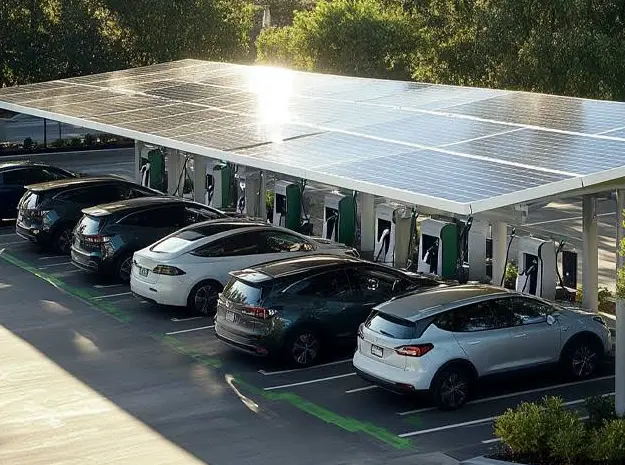
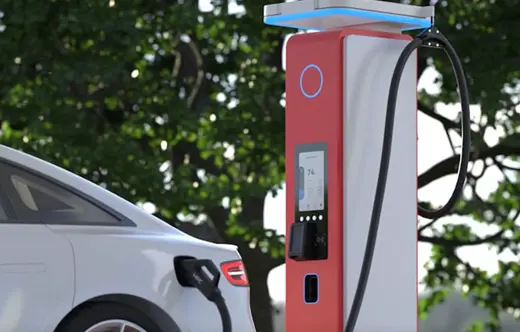
Choose AC charging when vehicles stay parked long enough for their onboard chargers to deliver the required daily energy. Choose DC charging when short dwell time or high vehicle throughput makes faster energy transfer operationally necessary. Rated charger power is only one part of the decision. Vehicle acceptance limits, grid capacity, charging demand by time of day, connector standard, civil works, load management and service responsibilities determine whether an AC or DC charging station will perform as expected.
A workplace with employee cars parked for eight hours can often serve more spaces economically with AC equipment. A highway stop, taxi turnaround point or logistics hub may lose operational value if each vehicle occupies a bay for several hours. The right comparison therefore starts with vehicles and parking behavior, then works backward to the electrical system.
The Electrical Difference Changes the Project Boundary
An AC charging station supplies alternating current to the vehicle. Conversion to battery-compatible DC takes place in the vehicle’s onboard charger, so the vehicle sets a hard ceiling on AC charging power. Connecting a car that accepts 7 kW AC to a 22 kW AC charger does not make the car draw 22 kW.
A DC station performs the main AC-to-DC conversion outside the vehicle and supplies controlled DC power through a compatible fast-charging interface. That architecture supports much higher charging rates, but it also adds power modules, thermal management, communication, a heavier cable system and a larger upstream electrical load. Vehicle battery temperature, state of charge and the battery-management strategy can still reduce the power accepted during a session.
IEC 61851-1 covers general requirements for conductive EV supply equipment, while IEC 61851-23 addresses DC EV supply equipment. Connector geometry and the charging protocol are separate compatibility questions. The destination market, vehicle fleet and local approval requirements must be confirmed before a product standard or connector family is frozen.
Use Dwell Time and Energy Demand as the First Filter
Parking duration is a more useful starting point than the word “fast.” Determine how much energy each vehicle needs before departure and divide that requirement by the realistic charging window. Then account for the vehicle’s charging limit, conversion losses, power sharing and any site demand cap.
A car needing 28 kWh during an eight-hour workplace stay requires only 3.5 kW on average before losses. The same energy delivered during a 30-minute stop calls for roughly 56 kW before losses and charging taper. Those are different infrastructure projects even though the vehicle receives the same energy.
The fleet schedule matters just as much as the average. Twenty overnight vehicles can be sequenced through a managed AC system if departures are known. Five delivery vehicles arriving together for short breaks may create a concentrated DC demand. Arrival data, initial state of charge and the required departure state of charge should therefore be modeled by time interval rather than summarized as a daily kWh total.
| Project factor |
AC charging is usually stronger when |
DC charging is usually stronger when |
| Vehicle dwell time |
Vehicles remain parked for several hours or overnight |
Vehicles must return to service quickly |
| Energy per session |
Daily energy can be restored within the available parking window |
Large energy increments are required in a short stop |
| Vehicle compatibility |
The fleet has suitable onboard AC charging capacity |
The fleet supports the selected DC interface, voltage range and protocol |
| Site electrical capacity |
Power can be distributed across more ports with scheduled or dynamic control |
The connection and distribution system can support high coincident demand |
| Operational priority |
Coverage, parking access and lower power per bay matter most |
Bay turnover and energy delivered per hour matter most |
| Maintenance model |
A simpler distributed equipment base fits site capability |
The operator can support power-electronics service and uptime management |
Why Rated Power Does Not Equal Charging Speed

The actual charging rate is governed by the lowest applicable limit in the chain: available site power, charger output, cable and connector capability, vehicle charging hardware, battery-management commands and temperature-related controls. A project model based only on the station nameplate will overstate throughput whenever one of those constraints is lower.
For AC charging, the vehicle’s onboard charger is often the decisive limit. Dingsheng’s 22 kW AC charging pile is listed with a three-phase input, column or wall installation and wired communication options. Those product details establish an equipment reference; they do not prove that every vehicle will charge at 22 kW or that the destination electrical system uses the same voltage, connector and approval basis.
DC charging introduces a different limitation. A station may have a high aggregate rating, but a vehicle can request less power as its battery warms, cools or approaches a high state of charge. With multi-connector equipment, the allocation logic also matters. “Dual gun” does not automatically mean that both connectors deliver the full cabinet rating at the same time. The quotation should state total cabinet power, per-connector limits and the sharing behavior under simultaneous use.
Grid Capacity and Utilization Must Be Evaluated Together
Installing more nameplate power than the site can supply leads to derating, expensive grid work or demand peaks that undermine the operating case. Yet designing the connection for the sum of every charger at full output may also be unnecessary if the vehicles and dwell schedule permit managed charging.
For AC sites, dynamic load management can allocate a fixed site capacity across many ports. This often favors workplaces, hotels, residential parking and overnight fleets, where charging can be shifted without affecting departure readiness. The engineering study still needs transformer capacity, switchgear rating, feeder routes, voltage drop, earthing, protection and the maximum facility demand.
DC sites concentrate more power at fewer bays. That can improve throughput, but it raises the importance of transformer and switchgear capacity, fault level, demand management, cooling, cable routing and utility constraints. Where the grid connection is limited, a staged rollout or energy storage may be more practical than assuming an immediate service upgrade. Any such support system should be modeled against the charger arrival pattern rather than added as a generic accessory.
The charging station product range provides AC and DC equipment references for early screening. Site architecture should be fixed only after the electrical study and vehicle-use model agree on the number of ports, coincident power and required session outcome.
Connector, Protocol and Software Compatibility Are Separate Decisions
A charger can have the right power rating and still be unsuitable for the fleet. Confirm the physical connector, vehicle inlet, charging mode, communication protocol and market-specific requirements. For mixed fleets, use a vehicle matrix that identifies each model’s AC acceptance, DC acceptance, voltage range and connector.
Back-office integration deserves its own scope. Authentication, payment, user access, remote monitoring, tariff management, smart charging, fault alarms and data ownership may be handled by different platforms. Ethernet or cellular connectivity is only the transport layer; it does not prove compatibility with the operator’s preferred management system.
Ask for a protocol list, software-responsibility matrix and demonstration plan. The supplier should identify licensing, SIM or network dependencies, remote-service access, data retention, cybersecurity responsibilities and what remains functional if communication to the backend is lost. These details have a direct effect on commissioning and station availability.
Compare Installed Service Capacity, Not Charger Purchase Price
AC equipment generally places less conversion hardware at each charging point, while DC equipment brings substantial power electronics into the station. That distinction affects more than purchase price. The installed comparison should include transformer or service upgrades, switchgear, cabling, trenching, foundations, protective equipment, communications, software, commissioning, spare parts and maintenance access.
Utilization changes the economics. A lightly used DC charger may carry high infrastructure cost without generating enough paid sessions or fleet value. Conversely, a low-cost AC installation can fail operationally if vehicles cannot receive their required energy before departure. Cost per installed port, cost per available kW and cost per delivered session answer different questions.
For high-turnover sites, Dingsheng also lists a 160 kW dual-gun DC charging pile. Use it as a DC equipment reference only after confirming the target vehicles, connector and protocol, per-gun power allocation, output range, site supply and required market approvals. A catalog rating should never replace the vehicle-to-grid compatibility review.
Acceptance Should Reproduce the Intended Operating Scenario
A power-on check does not prove that a charging station meets the project duty. Factory acceptance can verify the contracted model, protection functions, interfaces, configured options and available test records. Site acceptance then needs to verify installation, earthing, upstream protection, communications, emergency functions and charging behavior with representative vehicles or approved test equipment.
For managed AC charging, demonstrate how the system behaves when several vehicles connect and the site reaches its import limit. For dual-connector DC equipment, record power allocation during simultaneous sessions. Network interruption, emergency stop, recovery after a supply loss and alarm reporting should be included where relevant to the agreed scope.
The test procedure should identify the measurement point, test vehicle or simulator, initial state of charge, environmental conditions and pass criteria. Without those controls, two suppliers may both report a successful charge while proving materially different performance.
Prepare an AC vs DC Charging Station RFQ
A decision-ready RFQ gives the supplier enough information to validate the charging route rather than merely quote the nearest product. Include:
- installation country, grid voltage, frequency, earthing arrangement and available connection capacity;
- vehicle models, battery sizes, AC and DC charging limits, connectors and expected fleet changes;
- arrival times, dwell windows, energy required before departure and simultaneous-session assumptions;
- number of ports, indoor or outdoor conditions, cable reach, mounting, civil constraints and accessibility needs;
- authentication, payment, backend, communication, remote monitoring and load-management requirements;
- required documents, factory tests, site tests, commissioning, training, spares and service boundary;
- quantity, delivery destination and commercial delivery basis.
Request a reply that separates the offered charger configuration from optional infrastructure and services. It should show connector and protocol, continuous and per-port power, power-sharing logic, input requirement, protection and communication scope, environmental limits, documentation, testing, exclusions and all deviations from the RFQ. Normalize those items before comparing price or delivery time.
Frequently Asked Questions
Is a 22 kW AC charger always three times faster than a 7 kW AC charger?
No. The vehicle’s onboard charger and the available site power limit AC charging. A vehicle that accepts 7 kW AC will not take 22 kW simply because it is connected to a higher-rated station.
Can every electric vehicle use a DC fast charging station?
No. The vehicle must support DC charging through a compatible connector, protocol and voltage range. Some plug-in hybrids and older vehicles do not support DC fast charging.
Does a dual-gun DC charger provide full rated power to both vehicles?
Not necessarily. The cabinet may share a fixed total output between connectors. Confirm total power, per-gun maximum, allocation rules and behavior when two vehicles charge simultaneously.
Can one project combine AC and DC charging?
Yes. A mixed site can use AC ports for long-stay vehicles and reserve DC bays for short-turnaround demand. The electrical design and management system must coordinate the combined maximum load.
Move From Charger Type to a Comparable Proposal
Send the vehicle matrix, parking schedule, electrical data and functional requirements through Dingsheng’s EV charging project inquiry form. Ask for a configuration schedule and deviation list rather than a price-only reply. That creates a fair comparison between AC and DC options and makes the selected station traceable to the site’s actual throughput requirement.